
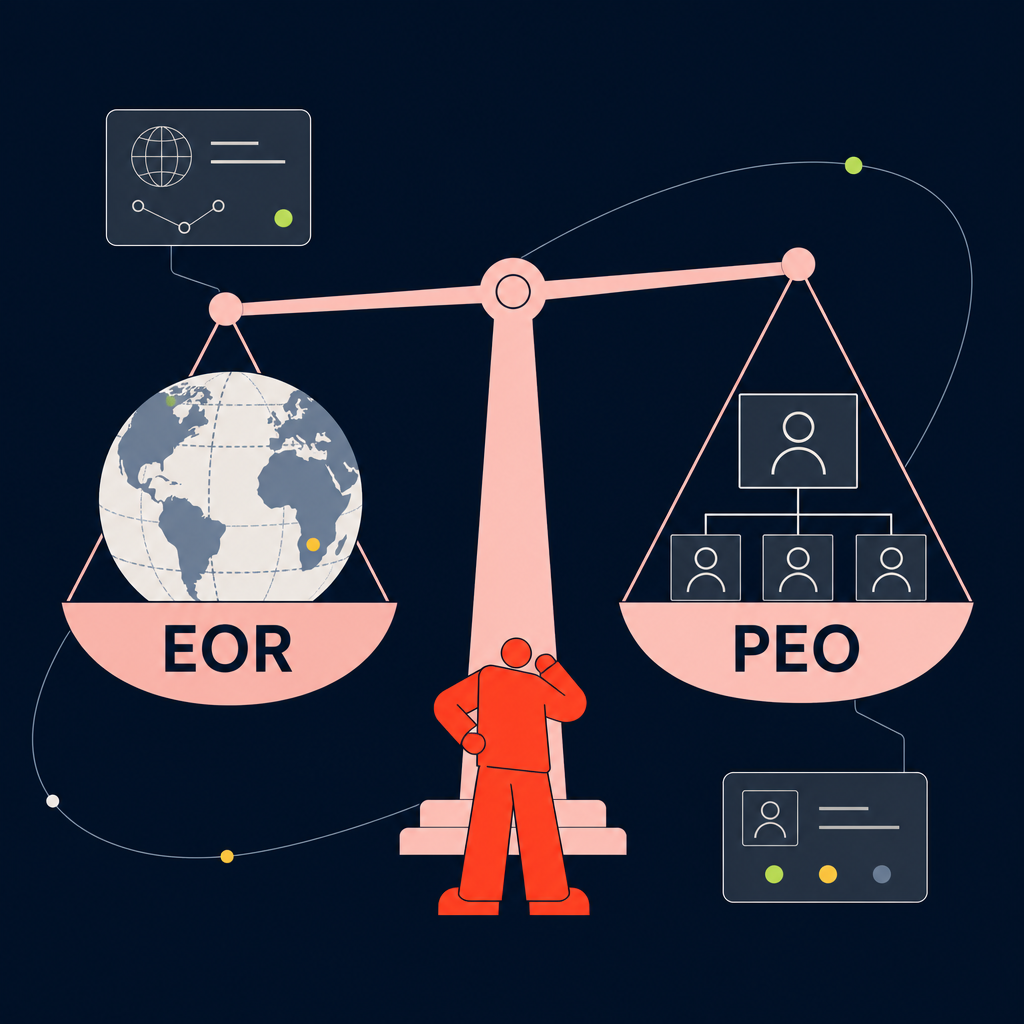
What is the difference between an EOR and a PEO?
An Employer of Record (EOR) acts as the legal employer for workers in a country where your company lacks a corporate entity, absorbing statutory employer liability, managing compliance, and running payroll. A Professional Employer Organization (PEO) operates through co-employment, requiring your business to own a registered local entity to co-manage administrative HR tasks.
Many expanding companies assume co-employment operates identically across domestic and international borders. In reality, co-employment requires both the provider and the client to hold registered legal entities in the same jurisdiction. Attempting to deploy domestic human resources outsourcing overseas without a local corporate entity creates severe legal exposure and stops international onboarding before it starts.
An EOR model allows organizations to hire international team members quickly and maintain legal compliance without setting up a foreign corporate entity, which often takes months and costs tens of thousands of dollars. By placing workers on the EOR's existing local infrastructure, companies bypass lengthy corporate registration steps while keeping full operational control over daily work assignments.
Under an Employer of Record framework, the legal provider absorbs employment risk, issues compliant local contracts, executes statutory payroll tax withholdings, and handles filings with regional labor authorities. Meanwhile, the client enterprise retains absolute ownership of daily directives, performance reviews, product deliverables, and internal team culture.
This operational division sets clear governance boundaries for expanding international teams:
- The third-party EOR provider absorbs statutory employment liability, handles local benefits administration, and executes tax filings.
- The hiring company manages day-to-day work output, project deliverables, and operational workflows.
- The organization avoids local entity formation fees, corporate tax registrations, and ongoing statutory maintenance.

Entity ownership: the core structural boundary between EOR and PEO
Entity ownership defines which party bears statutory employer liability and maintains local corporate tax registrations. Under a PEO framework, your business owns the local legal entity and shares administrative employer duties. Under an EOR framework, the service provider owns the entity, assumes complete legal liability, and enables hiring in countries where you hold no corporate footprint.
How PEO co-employment relies on your existing entity
A mandatory prerequisite for engaging a PEO is that your business must already own a registered local legal entity in the target country. Under a co-employment structure, statutory liability is shared between both organizations under regional labor law. The client business remains the primary employer on state registrations, while the PEO processes routine administration.
Because your business owns the underlying entity, you retain ultimate financial control and legal risk for statutory compliance, corporate tax obligations, and employment litigation. A PEO works best for companies with an established local corporate presence seeking to streamline internal operations. The administrative provider manages payroll processing and benefits administration directly beneath your local corporate infrastructure.
Companies operating under co-employment must continuously maintain local regulatory compliance, local banking rails (the regional networks that process payroll transfers), and annual tax filings. These ongoing administrative burdens make PEO models impractical for testing new foreign markets or managing isolated team members across several countries.
How EOR removes the need for local legal registration
An EOR eliminates the requirement for corporate registration by employing international workers through its own fully licensed, established legal entities. The provider serves as the sole employer of record under local labor law, drafting employment contracts that adhere to country-specific statutory requirements.
This structural distinction changes how leadership manages global expansion and workforce compliance:
- Entity requirement: A PEO demands an active local corporate entity, whereas an EOR operates entirely through the provider's local entities.
- Liability distribution: A PEO splits legal risk through co-employment, whereas an EOR absorbs statutory employer liability.
- Market entry speed: PEO hiring timelines depend on corporate registration speed, whereas an EOR enables rapid onboarding within days.
- Statutory payroll: A PEO runs payroll under client tax IDs, whereas an EOR handles filings under its own corporate accounts.
By outsourcing legal employer obligations to a partner with established local entities, enterprises expand abroad without incurring high legal formation costs or long setup timelines. Dissecting this structural boundary allows finance and HR leaders to choose the exact model required for their global footprint.
Key terms in global employment and workforce governance
Global employment governance relies on precise legal terminology to define co-employment relationships, tax liabilities, and worker status across jurisdictions. Clear definitions of these legal mechanisms protect enterprises from statutory tax penalties and operational friction when hiring international teams.
- Employer of Record (EOR): A third-party entity that legally employs workers on behalf of another business in a country where the client lacks a corporate entity. The EOR absorbs legal liabilities, manages local payroll taxes, and maintains statutory compliance. Because the EOR is the official legal employer, the client company directs daily work without registering a foreign business entity.
- Professional Employer Organization (PEO): An administrative partner that enters a co-employment model with a client business. Unlike an EOR, a PEO requires the client to own a registered local entity in that jurisdiction. The client retains direct employment operations while the PEO manages payroll and local administrative compliance.
- Co-employment: A legal structure where two organizations divide employer obligations under a shared contract. The administrative partner handles payroll tax filing and regulatory compliance, while the client retains authority over daily management and performance. Both parties split statutory risks based on the specific allocation of responsibilities set out in the service contract.
- Agent of Record (AOR): A contractor management model where a third-party provider validates worker classification, manages contractor agreements, and processes invoices. The AOR executes these tasks without establishing an employment relationship, giving companies a formal process to engage independent contractors while reducing misclassification risks.
- Permanent Establishment (PE): A foreign corporate tax exposure triggered when a business maintains a continuous, revenue-generating commercial presence in a foreign jurisdiction. If an employee or representative habitually negotiates contracts or generates revenue within a country, local tax authorities can deem the foreign enterprise subject to local corporate income taxes.
- Worker Classification: The legal assessment determining whether a worker is an independent contractor or an employee under regional labor laws. Local tax and labor authorities evaluate this status primarily through behavioral control—how much authority the company exerts over how work is performed—and financial dependency. Misclassifying an employee as a contractor exposes the business to retroactive payroll tax liabilities and statutory penalties.
Wondering how global hiring & contractor compliance plays out in your countries?
A Papaya specialist can map this to your actual workforce instead of the general case.
Selecting between EOR, PEO, and contractor management models
Choosing between EOR, PEO, and contractor management depends on headcount scale, long-term market strategy, and classification risk. Organizations usually enter new regions using contractors or EOR partners for speed, then transition mature international teams onto owned local entities managed through internal payroll or PEO models as headcount scales.
Managing growth trajectories from EOR to owned entity
Fast-growing enterprises experience specific operational inflection points as their global workforce expands. In early market entry, hiring two or three team members through an EOR allows a company to evaluate regional talent pools without committing capital to entity formation. As headcount expands toward fifteen or twenty workers, however, cumulative monthly EOR platform fees eventually exceed the fixed cost of establishing and managing a local entity.
At this financial inflection point, organizations initiate corporate registration and transition workers from EOR platforms to direct entity payroll. For example, Datadog moved roughly 15 EOR-based international teams to Papaya and later transitioned two EOR countries to its own entities with support. Similarly, Kong used EOR to hire in new markets before setting up local entities, then transitioned workers as its entity strategy changed.
This structured migration model allows enterprises to scale cleanly while preserving financial control:
- Initial Market Entry: Onboard international talent through EOR entities without local setup delays.
- Headcount Validation: Establish local operational footprint and verify commercial viability.
- Entity Formation: Incorporate a local legal entity once worker volume offsets registration and legal fees.
- Workforce Transition: Move team members from EOR contracts to direct local payroll systems.
Aligning worker classification with governed operating workflows
While direct employment models suit core long-term staff, growing enterprises frequently rely on international contractors for specialized expertise. Engaging cross-border contractors without standardized compliance reviews creates severe exposure under statutes like IR35 (the UK off-payroll working rules) or local misclassification standards. Treating independent contractors like full-time staff can trigger statutory tax penalties, back-pay claims, and unexpected audit liabilities.
Organizations must implement clear governance workflows that separate employee management from contractor engagement:
- Classification Workflows: Evaluate project scope, behavioral control, and financial independence before signing contracts.
- Contract Standardization: Use localized agreement templates that establish clear independent contractor status.
- Document Governance: Maintain centralized audit-ready worker records including tax forms, business registrations, and right-to-work verifications.
- Approval and Payment Coordination: Execute cross-border contractor payouts through dedicated workflows to maintain clear audit trails.
When contractor engagement becomes improper due to high behavioral control or integral responsibilities, companies must transition those roles to formal employment. Relying on an EOR provider or establishing direct entity payroll protects the enterprise from misclassification liabilities while preserving team productivity.
To review compliance guidelines for self-employed talent, consult our IR35 status guide.

Building a governed operating layer for your global workforce
Building a governed operating layer requires unifying contractor management, Employer of Record (EOR) hires, agency staff, and direct entity employees inside a single platform. Centralizing these workforces eliminates fragmented local software, standardizes approval workflows, ensures continuous audit readiness, and delivers complete financial control across all international team members.
Managing international workers across multiple regions without integration creates fragmented HR software, decentralized records, and compliance risk. When an enterprise expands internationally, leadership often uses distinct mechanisms to engage talent across different markets. They hire independent contractors for specialized project work, contract with EOR providers for rapid market entry without local incorporation, run direct payroll for established foreign subsidiaries, and engage local agencies for temporary staffing.
When finance and HR teams operate these engagement models in isolation, operational problems multiply. Finance teams track independent contractors through manual invoice approval workflows in accounts payable. At the same time, regional HR managers track EOR workers and local entity payroll across separate spreadsheets and regional payroll software portals. This disconnected structure forces administrative teams to reconcile mismatched payment cycles, currency conversions, varied tax documentation, and local reporting rules every month. Administrative friction increases with every new hire. This friction slows down month-end financial closing and creates persistent errors in total labor expenditure tracking.
When contractor invoices, EOR billings, and local entity payroll sit in separate systems, finance leaders cannot calculate the true cost of their international workforce in real time. A variance in regional payroll processing dates or an unrecorded contractor invoice distorts quarterly budget projections. Decentralized worker records also create compliance exposure. Local tax rules, worker classification laws, mandatory statutory benefits, and termination requirements vary across jurisdictions. Storing worker contracts, tax declarations, and payment records inside local desktop folders or regional vendor portals leaves organizations vulnerable during regulatory audits.
A unified global workforce infrastructure resolves this operational friction under a single operating layer. By consolidating worker records, approval hierarchies, tax forms, and payment schedules into one central system, HR and finance leadership gain clear visibility into total talent costs, contract terms, classification status, and local compliance posture across every operating country. Centralizing worker management, approval workflows, and cross-border payments removes duplicate administrative tasks while maintaining continuous audit readiness.
Papaya Global provides this centralized control. The platform enables organizations to manage independent contractors, direct EOR hires, and local entity payroll across 180+ countries. Instead of coordinating multiple local payroll vendors and manual bank transfers, finance teams approve payments and review workforce data through a single platform interface. Standardized workflows guarantee that worker contracts, local tax withholding calculation rules, contractor invoices, and payment approvals follow identical operational protocols regardless of worker location.
Whether an organization relies on international contractors, engages EOR providers for initial market entry, hires agency workers, or runs direct payroll through owned legal entities, standardized global operations provide compliant execution across every border. Unifying these functions gives executive leadership the control required to scale international operations without expanding administrative headcount or incurring regulatory penalties.
To explore how unified infrastructure simplifies cross-border operations, review our contractor payment platform.
You can also explore our full suite of global employment solutions to manage your global workforce.
Understand EOR vs. PEO: Simplify your global hiring.
Frequently asked questions
How does an EOR differ from a PEO for international hiring?
An EOR acts as the legal employer for international workers in countries where your business lacks a corporate entity, absorbing statutory employer liability, payroll taxes, and local compliance under its own corporate infrastructure. Conversely, a PEO requires your company to hold a registered local legal entity in the target country, operating under a co-employment model to process routine administrative HR duties.
When should a company use a global EOR rather than establish an entity?
A business should engage a global EOR when entering a foreign market rapidly, testing commercial viability, or hiring isolated workers without incorporating locally. Establishing a corporate entity often takes months and incurs significant capital expenses. An EOR allows organizations to onboard talent compliantly in days while evaluating long-term corporate expansion plans.
When is a global PEO the right operating model?
A global PEO is the appropriate model when your organization already holds a registered legal entity in the target jurisdiction but wants to outsource HR operations. This structure allows companies with existing corporate registrations to streamline payroll processing, tax filings, and benefits administration while maintaining shared co-employment oversight.
How does EOR payroll operate across countries?
EOR payroll operates by placing cross-border workers on the established legal entities of the EOR partner. The provider calculates statutory tax withholdings, submits mandatory filings to local labor authorities, guarantees local legal compliance, and disburses net wages in local currency, sending the client business a single consolidated monthly bill.
The next step is global hiring & contractor compliance in your own setup
Bring your countries, worker mix and payment cycles to a Papaya specialist and get a straight answer on what changes.