
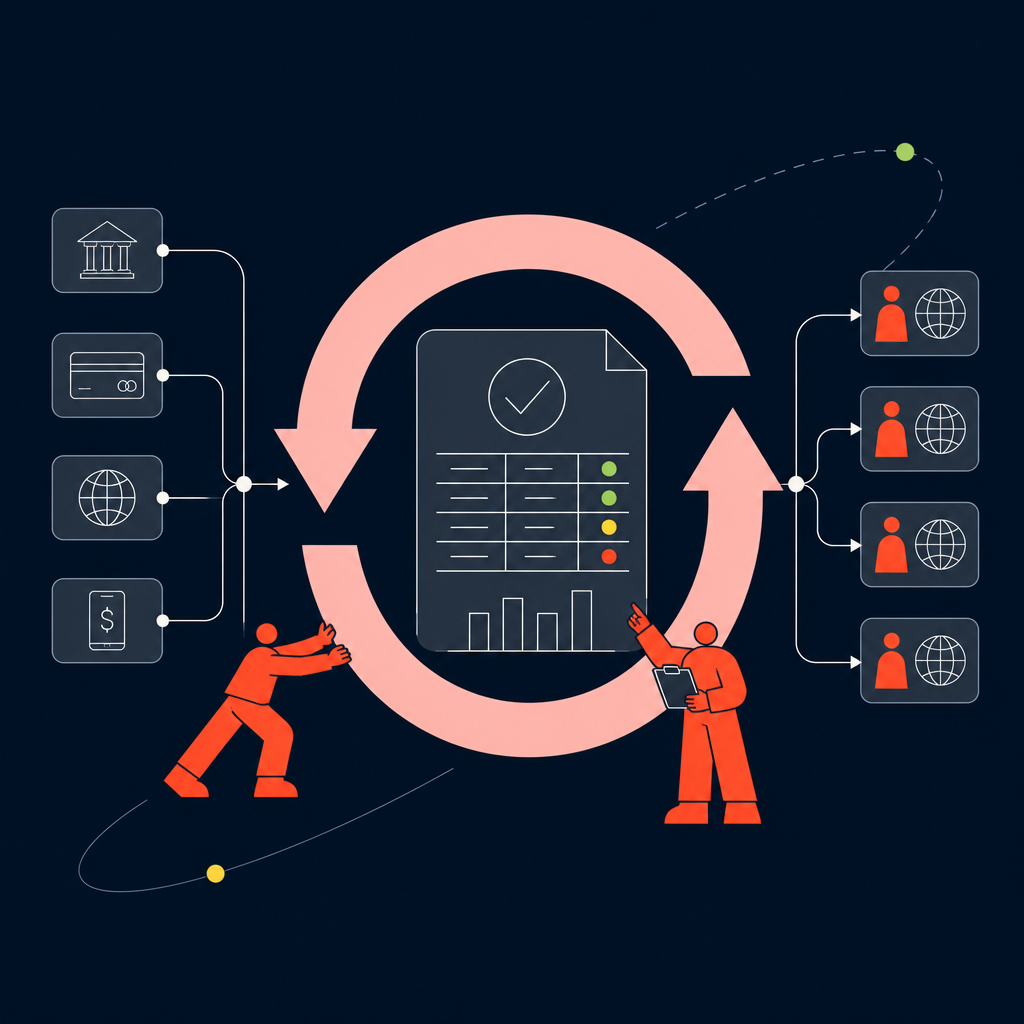
The payment reconciliation process is the systematic internal accounting control that compares general ledger entries against external bank statements to confirm that every outbound and inbound transaction matches perfectly.
What is the payment reconciliation process in modern finance?
The payment reconciliation process is the internal accounting control that verifies matching balances between ledger entries and actual bank account statements. In modern corporate finance, this control validates that funds leaving corporate accounts equal approved invoices, preventing financial leakage, unrecorded bank charges, and inaccurate balance sheet reporting across global operating entities.
For mid-sized enterprises managing hundreds of international contractors across Europe, the UK, and Latin America, manual ledger balancing creates operational bottlenecks. Finance teams often spend days cross-referencing CSV (comma-separated values) exports from legacy banking portals against internal purchase orders.
As transactional volume grows, manual spreadsheets introduce human error. Missing invoice numbers, unannounced currency conversions, and delayed settlement notices leave finance leaders guessing which workers received their payouts and which transfers bounced.
The primary operational mandate of the payment reconciliation process is to ensure that the figures in a business's bank statements match its accounting records. When operating across international borders, this verification requires tracking every cent across multiple intermediary banking networks.
The core goal of payment matching
Financial reconciliation establishes absolute truth between internal expectations and external execution. Without continuous matching, balance sheets carry unverified amounts that compromise audit readiness and distort financial reporting.
Maintaining tight payment alignment serves four specific operational objectives for corporate finance teams:
- Verifying ledger completeness across all active subsidiary accounts.
- Detecting unrecorded processing fees, FX (foreign exchange) markups, and correspondent bank deductions.
- Identifying failed or returned international wire transfers early.
- Maintaining clear audit trails for internal controls and tax compliance.
Why cross-border contractor payouts create reconciliation friction
Contractor-powered businesses face unique reconciliation challenges compared to domestic, payroll-only organizations. Independent contractors submit invoices at varying intervals, in local currencies, and through different payment channels.
When a company executes a mass payment run across 20 countries, correspondent banks often strip out payment reference numbers during transit. The receiving bank processes a net sum, while intermediary institutions deduct handling fees along the wire pathway.
Consequently, the line item appearing on the corporate bank statement rarely matches the gross invoice amount recorded in accounts payable. Finance staff must manually investigate these variances, turning routine invoice clearing into a labor-intensive reconciliation exercise.

The core building blocks of global payment matching
Global payment matching relies on three structural components: synchronized source invoices, standardized transaction metadata, and clear balance adjustments. Finance teams use these structural building blocks to trace capital from original invoice approval through bank settlement, accounting for foreign exchange variances and intermediary transaction fees at each stage of execution.
Source record synchronization and invoice clearing
Before a finance department can match bank statements to internal books, source documents must be structured consistently. Invoices must contain standardized worker identifiers, explicit tax registrations, pre-approved purchase order numbers, and specified settlement currencies.
When an invoice moves to clearing, the accounting system generates an internal payment voucher. This voucher serves as the baseline record against which incoming bank settlement files are evaluated.
If the banking network processes payouts without preserving unique voucher IDs, matching breaks down. Organizations must establish rigid metadata fields across their billing workflow to maintain direct traceability between bank statement lines and internal general ledger accounts, ensuring that bank statements match internal financial records accurately.
Handling intermediary fee deductions and FX rate slippage
Cross-border payouts pass through intermediary banks within the SWIFT (Society for Worldwide Interbank Financial Telecommunication) network. Each institution along the route may assess a handling fee, often deducted directly from the principal transfer amount.
Additionally, foreign exchange rates fluctuate between invoice approval and bank execution. A contractor billed in Euros but paid from a British Pound treasury account introduces rate slippage into the transaction lifecycle.
To clear these line items without leaving open balances in accounts payable, finance operations must establish variance thresholds. The accounting model must automatically categorize small discrepancies into dedicated ledger accounts for currency loss or banking service charges rather than flagging them as unpaid invoices.
Key payment reconciliation terms explained
Wondering how cross-border payment operations plays out in your countries?
A Papaya specialist can map this to your actual workforce instead of the general case.
Financial reconciliation relies on precise terminology to describe payment states, settlement pathways, and ledger discrepancies across international operations. Managing cross-border contractor payouts requires finance teams to track funds across different banking jurisdictions, clearing networks, and currencies. Mastering concepts such as foreign exchange slippage, intermediary lifting fees, batch settlement, and break resolution allows finance teams to diagnose matching failures, maintain financial control, and audit cross-border contractor payout structures efficiently.
When accounting records do not align with bank statement data, monthly ledger closes stall. International transactions move through multiple handling institutions, creating points where values change or clearing dates shift. Standardizing payment terminology helps accounting staff categorize ledger variances quickly, separating routine bank processing fees from actual payment errors or missing funds.
Essential reconciliation terminology
Navigating global banking protocols requires a precise understanding of specialized financial terms:
- Matching break: An unresolved discrepancy between an internal accounting voucher and a corresponding bank statement entry. Matching breaks occur when automated software rules fail to pair a ledger debit with a bank clearing entry due to differing line-item values, missing reference metadata, or timing mismatches. If an invoice is booked at 1,000 USD but the bank statement shows 985 USD cleared, the system flags a break. Resolving a matching break requires manual research to trace the root cause and apply correcting journal entries.
- Intermediary lifting fee: A processing charge deducted by correspondent banks during cross-border wire transfers, reducing the final payout amount received by the beneficiary. When funds travel through SWIFT networks involving multiple correspondent institutions, each bank along the routing path may deduct a fee directly from the principal transfer amount. This reduction leaves the recipient with less money than the sender remitted, causing a ledger break between the original accounts payable voucher and the final bank debit.
- Foreign exchange slippage: The monetary difference caused by exchange rate fluctuations between payment initiation and final clearing. Spot rates move continuously in foreign exchange markets, meaning the rate applied when a payment request enters the queue often differs from the rate applied when the transaction clears. This shift creates an unreconciled variance in domestic currency values that finance teams must record in realized foreign exchange gain or loss accounts.
- Batch settlement: The process of consolidating multiple individual contractor invoices into a single net debit against the corporate treasury account. Payment operations use batch processing to aggregate contractor invoices into one primary wire transfer, reducing banking transaction charges. For reconciliation, accounting systems must unbundle the single lump-sum bank debit into individual sub-ledger payments to close out open accounts payable items.
- Land date: The verified calendar date on which funds clear all correspondent checks and arrive in the recipient's bank account. Land date differs from payment execution date, which records when the originating bank released the payment order. Intermediary compliance reviews and local clearing schedules often delay settlement by several business days. Tracking the land date provides accurate confirmation of when funds reach a contractor, helping teams resolve payment timing disputes.
- Proof of payment: An official banking confirmation document verifying that funds were successfully credited to a named beneficiary account. Financial institutions issue confirmation documents, such as SWIFT MT103 messages, that detail the unique reference number, beneficiary account details, value date, and settlement status. Finance departments rely on proof of payment records to verify transfer completion and close contractor delivery inquiries.
Establishing a shared understanding of these terms helps finance leaders standardize their payment operating models across multiple corporate entities. Maintaining explicit definitions across global teams prevents miscommunication during monthly ledger closes and simplifies bank statement reconciliation procedures across distributed entities. When internal teams apply uniform criteria to settlement failures, financial controllers can audit cross-border cash flows without spending hours reconciling minor bank fee variances.
Automating recurring payment cycles and exception handling
Automating recurring payment cycles relies on rule-based engines and pattern recognition software that pair bank line items with internal invoice records. By parsing metadata, currency codes, and contractor tax identifiers automatically, these platforms eliminate manual data entry while isolating unmatched items into dedicated exception workflows for rapid human review.
Pattern recognition and automated invoice matching
Legacy matching tools relied strictly on exact string matching. If a bank statement reference omitted a single hyphen or altered an invoice prefix, the transaction failed validation and required manual review by an accountant.
In a 2025 research publication on enterprise finance trends, treasury analysts noted that machine learning algorithms learn from historical settlement patterns to pair incoming bank lines with open ledger invoices automatically, even when transaction metadata is incomplete or inconsistent.
Looking toward 2026 operational priorities for B2B CFOs, intelligent matching engines dynamically associate vendor payment habits with incoming bank files, bypassing rigid rules-based constraints.
By analyzing historical timing, beneficiary details, and recurring transaction values, automated systems reconcile complex batch payments directly. This pattern-matching capability is particularly effective for high-volume mass payment workflows for global contractors, where hundreds of recurring invoices clear simultaneously across multiple currencies.
Modern intelligence platforms ingest unstructured bank data and infer which open invoices correspond to net wire transfers. As highlighted in recent treasury studies on automated payment workflows, machine learning models resolve variations in beneficiary naming and intermediary fee subtractions without requiring explicit database matches for every field.
Resolving payment exceptions without manual intervention
When automated matching fails to find a confident pair, the transaction enters an exception queue. Rather than halting the entire ledger closing process, modern financial architectures isolate the unmatched entry while clearing the rest of the batch.
Exception engines automatically route flagged items based on rule hierarchies:
- Tolerance matching: Discrepancies within predefined currency limits (such as under 5 USD) automatically route to an FX loss or fee expense account.
- Metadata enrichment: Unmatched lines query secondary banking metadata to locate missing reference tags.
- Beneficiary lookup: Payments with altered recipient names match against verified tax records and bank account details.
- Escalation tagging: Persistent breaks route directly to responsible regional managers with contextual transaction histories attached.
By handling routine variances automatically, finance operations teams only spend time investigating genuine discrepancies, such as altered bank details or recalled wire transfers. Papaya Global provides structured infrastructure to streamline these recurring payout flows, giving enterprise organizations financial control over global workforce payments while maintaining strict audit readiness.
Establishing a scalable contractor payment operating model
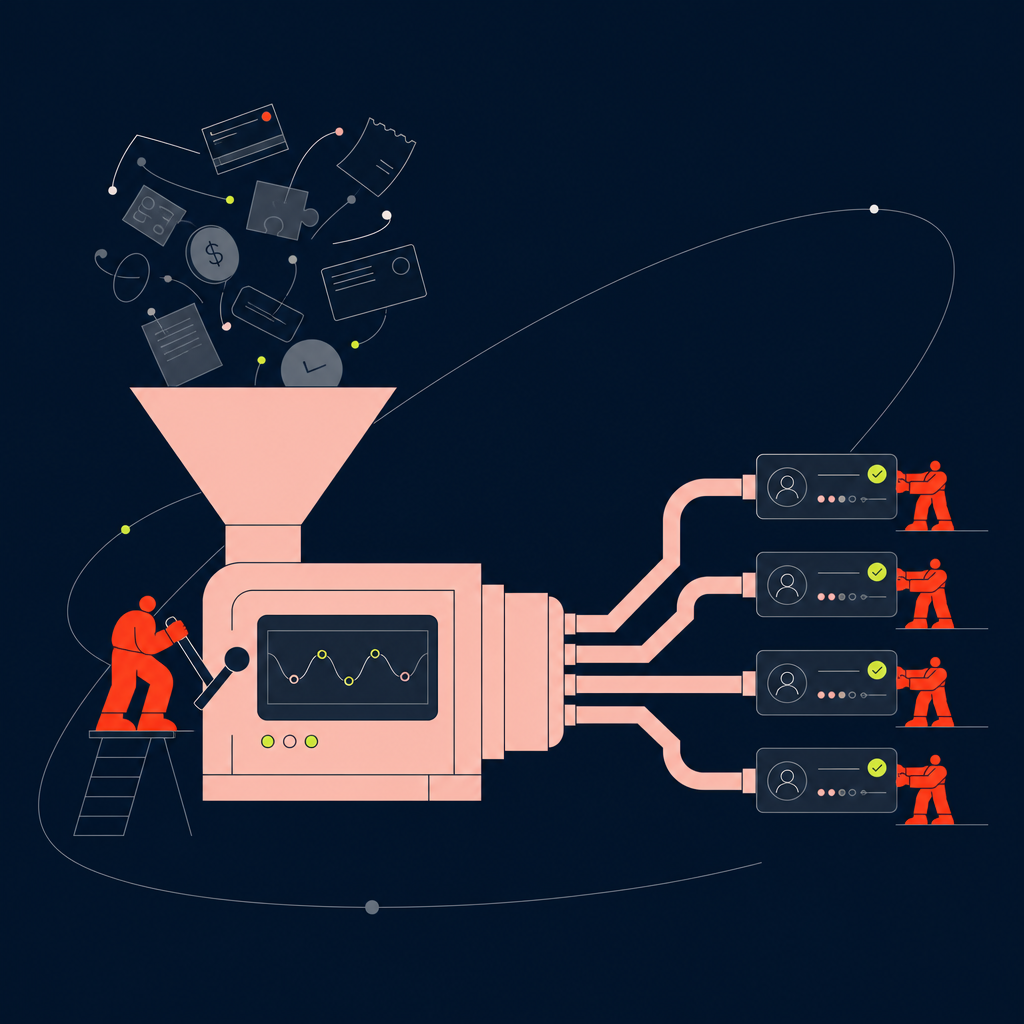
A scalable contractor payment operating model connects worker onboarding, invoice ingestion, foreign exchange management, and bank settlement into a single architecture. Finance operations maintain strict control over payment funding and execution schedules while providing real-time transaction visibility across internal accounting tools and international banking partners.
Transitioning to real-time payment status visibility
Traditional finance setups rely on end-of-month reconciliation. This batch approach forces finance managers to react to payment errors weeks after funds leave corporate accounts, damaging worker trust when international transfers stall.
Transitioning to continuous reconciliation requires integrating payment rails (the local banking networks that move money) directly with internal financial systems. Instead of waiting for monthly bank statements, modern platforms process real-time statement feeds to confirm when funds settle in recipient accounts.
Maintaining continuous balance checks ensures that internal accounting records match actual bank settlement lines throughout the monthly operating cycle. Real-time ledger updates give executive leadership workforce visibility into global cash positions and unbilled contractor liabilities at any given moment.
By adopting enterprise contractor payment platforms, organizations replace fragmented spreadsheets with centralized financial controls. Papaya Global enables growing enterprises to run standardized contractor payment operations across multi-country rosters, delivering precise foreign exchange control, automated ledger clearing, and reliable worker payment experiences across 180+ supported countries for workforce coverage.
Download our guide to streamline your global payment reconciliation process.
Frequently asked questions
What is the payment reconciliation process and how does it work?
The payment reconciliation process is an accounting procedure that verifies that internal transaction records match the statement entries provided by financial institutions. It works by importing bank feeds and general ledger data, comparing transaction amounts and reference numbers, and identifying variances caused by fees, timing differences, or unrecorded items. Any discrepancies are corrected in the general ledger to ensure balance sheet accuracy.
How can Finance automate recurring contractor payment reconciliation?
Finance teams automate recurring contractor reconciliation by deploying platforms that integrate billing software with global banking rails. These systems use rule-based engines and pattern recognition to match incoming invoices to net bank debits automatically. By pre-defining allowable variance thresholds for intermediary bank fees and currency conversions, the system clears matching transactions instantly and routes only unresolved exceptions to accountants for manual review.
Why does cross-border reconciliation fail for international contractors?
Cross-border reconciliation often fails due to data loss across international correspondent banking networks. When wires pass through intermediary institutions, original invoice references are frequently truncated, and unexpected lifting fees are deducted from the principal amount. These variations cause internal purchase orders and net bank debits to mismatch, requiring manual intervention to trace missing metadata and balance ledger entries.
How should Finance evaluate mass payment solutions for contractor reconciliation?
Finance leaders evaluating mass payment solutions should prioritize platform capabilities around automated reference tracking, transparent FX management, and real-time transaction status visibility. Key selection criteria include the platform's ability to ingest multi-currency invoices, automatically categorize intermediary banking charges, integrate directly with existing ERP (enterprise resource planning) accounting ledgers, and provide definitive proof of payment for global compliance auditing.
The next step is cross-border payment operations in your own setup
Bring your countries, worker mix and payment cycles to a Papaya specialist and get a straight answer on what changes.