

What is a multi currency payment gateway?
A multi currency payment gateway is an infrastructure layer that enables companies to execute cross-border payouts and collect funds across different currencies through local banking networks. It routes transactions directly into domestic clearing rails rather than relying on international financial intermediaries. By bypassing correspondent banking chains, the gateway reduces transfer delays, locks in foreign exchange rates upfront, and eliminates hidden intermediary bank charges that lower total settlement values.
Finance teams managing overseas contractors frequently face operational strain and foreign exchange exposure when paying international workforces. Standard international wire transfers pass through multiple correspondent banks. Each institution along the payment chain deducts handling fees and alters conversion margins before forwarding the remaining balance. Implementing a direct payment routing layer allows finance departments to execute cross-border transactions systematically. Using multi-currency payments allows businesses to pay contractors in their preferred local currency while paying international employees in a different currency, keeping payroll operations organized across distinct payment schedules.
How multi-currency routing replaces legacy SWIFT wires
Legacy international wire transfers rely on the SWIFT network, which functions as a messaging system rather than a direct settlement network. When a UK company sends British Pounds to a contractor in Brazil, SWIFT transmits administrative instructions across intermediate financial institutions. The actual funds move sequentially through these intermediary correspondent banks before arriving in South America converted into Brazilian Real. Every stop along that correspondent path introduces administrative friction, unpredictable landing dates, and unexpected fee deductions that alter the final deposit amount.
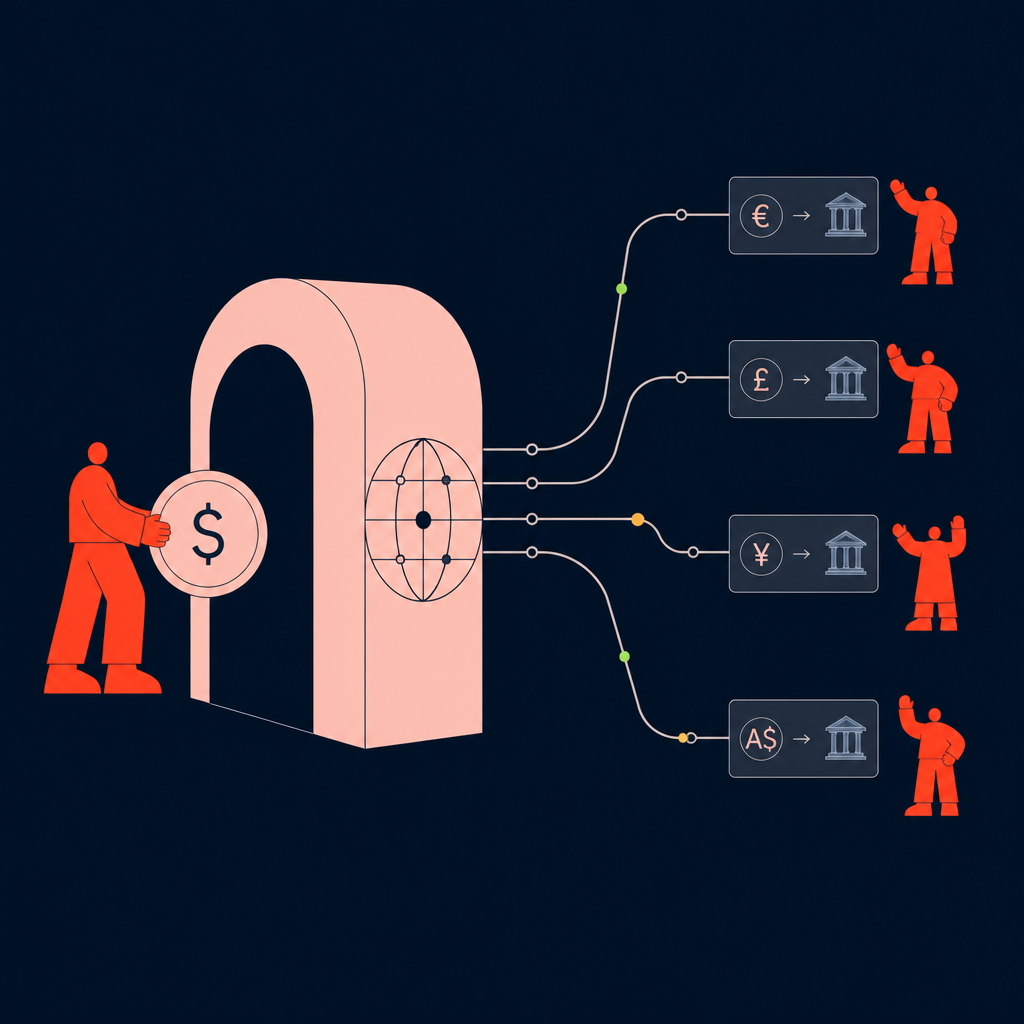
A multi-currency gateway replaces this process by establishing connected local bank accounts within target geographic regions. Instead of initiating an international wire through SWIFT, the gateway converts the currency upfront at locked rates and releases local currency from a bank operating inside the recipient's domestic clearing network. The recipient receives a standard local clearing deposit through domestic payment systems like Pix in Brazil or Faster Payments in the UK. Because the payment moves through domestic rails, the transfer avoids international processing holds.
This structural shift gives corporate treasury direct financial control over international cash flow. By eliminating manual wire creation in online banking portals, finance managers protect corporate balance sheets against spot-rate volatility and human entry errors. Payout execution turns from an unpredictable manual task into a structured operational routine. This framework gives finance leaders full visibility over transaction timing, domestic clearing schedules, and exact settlement amounts across all international corporate accounts.
Core foundations of cross-border contractor payouts
Cross-border contractor payout foundations rely on three core mechanisms: local currency funding, automated FX conversion, and direct domestic clearing. These systems allow finance teams to fund payouts from a central treasury account, convert currencies at locked rates, and deposit payments through domestic rails, ensuring precise land dates, financial control, and consistent settlement values.
To implement this infrastructure effectively, finance teams must first master the technical terminology underlying cross-border payment rails. Connecting treasury funding directly to regional payment networks removes manual intervention and ensures compliance across jurisdictions.
Local currency settlement vs international wire transfers
The central operational tension in global contractor operations lies between central treasury funding and localized contractor preferences. Independent contractors expect exact invoice values delivered to their domestic accounts without surprise fee deductions. Both employees and contractors can receive multi-currency payments provided the company's payroll system supports multiple currencies and complies with local regulations in each country where the employee or contractor lives.
When payments process over legacy international wires, receiving banks often deduct landing fees ranging from $15 to $50 per transaction. Local currency settlement avoids these charges entirely by depositing funds through national payment rails such as SEPA in Europe, ACH in the United States, or equivalent local networks across Asia.
Automated FX conversion and rate lock mechanisms
Foreign exchange volatility introduces direct financial risk into recurring payout schedules. Manual FX processing leaves companies exposed to intraday exchange rate shifts, creating variances between approved invoice amounts and final bank debits.
Automated rate locking resolves this discrepancy by securing real-time exchange rates at the moment of invoice approval. The gateway calculates the precise conversion value, applies pre-negotiated FX margins, and locks the balance prior to execution.
Finance teams evaluate cross-border settlement mechanisms across four specific operational criteria:
- Settlement Speed: Domestic payment rails clear transactions within hours or minutes, compared to two to five business days for international wires.
- Cost Transparency: Upfront foreign exchange locking eliminates unexpected intermediary wire fees and landing charges.
- Reconciliation Accuracy: Exact-match payout values ensure clear bookkeeping across multi-currency ledger entries.
- Contractor Retention: On-time payments in local currencies improve the talent experience and build trust with overseas workers.
Centralizing these mechanics prevents administrative leakage and provides operational stability during mass payout cycles.
Glossary of key multi-currency payment terms
Key multi-currency payment terms describe the financial rails, clearing rules, and foreign exchange structures governing international money movement. Mastering concepts such as local clearing rails, rate locking, correspondent banking, and payment grouping enables finance teams to evaluate payout software, maintain audit readiness, enforce financial control, and optimize global treasury workflows effectively.
To evaluate global payment tools accurately, finance teams must standardize their technical terminology. Here are the core definitions governing cross-border payment processing:
- Local Clearing Rails: Domestic interbank clearing networks (such as SEPA, Faster Payments, or ACH) that settle transactions between banks within a specific country or economic zone without crossing international borders.
- Correspondent Banking Network: A series of third-party intermediary banks that facilitate international wire transfers across borders for financial institutions that lack direct banking relationships in destination countries.
- Target-Currency Settlement: The payment execution model where the recipient receives the exact invoiced amount in their home currency, while the sender funds the transaction from their primary currency account.
- FX Rate Lock: A contractual mechanism provided by payment gateways that fixes foreign exchange rates for a specific time window, protecting companies from currency fluctuations between invoice approval and payout execution.
- Intermediary Bank Fees: Unpredictable administrative fees deducted by third-party banks along a SWIFT wire path, which frequently reduce the final amount received by the beneficiary.
- Payment Grouping: The operational process of aggregating multiple worker invoices into unified approval batches, enabling single-debit funding and synchronized batch processing across multiple regions.
- Land Date Guarantee: An operational assurance that funds will arrive in a contractor's bank account on a predetermined calendar date regardless of local clearing cut-off times.
- Payment Reconciliation: The automated matching of bank debit statements against invoice line items and internal ledger entries across multiple currencies.
Establishing these clear definitions inside finance operations eliminates ambiguity during cross-border ledger audits and software evaluation.
Building repeatable recurring payment cycles across 180+ countries
Building repeatable recurring payment cycles across 180+ supported countries for workforce coverage requires grouping worker invoices, establishing automated approval workflows, locking FX rates, and standardizing local rail routing. Integrating these steps into a structured operational cycle ensures on-time contractor payments, eliminates manual data entry, guarantees workforce visibility, and maintains audit-ready balance sheets across diverse currency accounts.
Eliminating manual friction in payment execution is only half the battle; maintaining visibility and control across every payout status resolves the remaining operational burden. Organizing payouts systematically protects treasury cash flow while supporting global scale.
Streamlining payment groups and local rail routing
Managing dozens of individual contractor payments across different timezone deadlines creates significant administrative overhead for corporate finance. Without structured payment grouping, finance managers must repeatedly upload individual payment files, manually verify bank details, and execute separate wire transfers across multiple banking portals.
Establishing structured payment groups allows finance teams to batch invoices by payout date, currency, or operational region. Operating a unified model across global operations requires broad coverage, supporting workforce coverage across 180+ supported countries while maintaining centralized control. Using a licensed contractor payment platform allows organizations to consolidate international workforce payments into structured operational batches.
Once payment groups are established, the gateway routes each payment to the appropriate local rail. A single funding debit from the corporate treasury account pays out contractors in Europe via SEPA, in the UK via Faster Payments, and in Latin America via domestic clearing networks.
Contractors benefit directly from this structure because paying contractors in their preferred currency eliminates local bank landing fees and reduces processing delays.
Choosing solutions designed to simplify global selling gives companies direct oversight of every stage of the payment cycle.
Automating FX risk control and invoice reconciliation
Manual reconciliation of multi-currency payouts creates severe bookkeeping backlogs. When exchange rates shift between the invoice approval date and the bank settlement date, finance teams must manually record foreign exchange gains or losses for every line item.
Automated platforms resolve this discrepancy by generating automated FX schedules and matching payment records directly against general ledger accounts. By standardizing execution timelines, finance teams lower operational costs and eliminate recurring payment errors.
A standardized monthly payment cycle follows five defined operational stages:
- Invoice Aggregation: Standardizing incoming contractor invoices into unified digital formats with verified task deliverables.
- Identity and Compliance Check: Automated verification of contractor tax forms, bank account details, and local regulatory requirements to ensure compliance.
- Batch Approval and Rate Locking: Securing spot exchange rates across all target currencies simultaneously upon finance approval.
- Single-Debit Funding: Funding the aggregate payout amount from a main corporate account in the company's primary currency.
- Domestic Clearing Delivery: Delivering funds over local rails directly into contractor accounts with guaranteed land date visibility.
Establishing this structured workflow prevents payment delays, reduces manual handoffs, and ensures complete financial control for treasury managers and global contractors. Papaya Global provides the infrastructure required to manage these global payment workflows without adding administrative headcount.

Gaining end-to-end finance control over global payouts
Gaining total finance control over global payouts requires shifting from fragmented banking portals to an integrated payment architecture. Relying on legacy banking portals across multiple countries forces finance teams to manage separate login credentials, distinct file upload formats, manual approval chains, and disconnected compliance tracking. As a business expands its international contractor base, the operational overhead of managing these separate banking relationships scales rapidly. Every new country added to a legacy banking setup multiplies administrative work and fragments financial oversight.
Consolidating payout operations into a centralized payment gateway establishes unified audit trails and strict approval hierarchies. In a decentralized setup, approving payments requires logging into individual regional portals and tracking authorization statuses on separate spreadsheets. A centralized gateway replaces these scattered steps with unified authorization rules. When finance managers approve a payment batch, the system enforces user permissions and records every authorization step automatically. This centralized governance protects financial controls while allowing regional teams to submit local payment requests for review.
Centralized payment systems ensure that both employees and contractors receive multi-currency payments, provided two conditions are met. First, the company's payroll system must support multiple currencies. Second, the payment workflow must comply with local financial regulations in each country where the employee or contractor lives. When these requirements are met, workers receive disbursements in their local currencies without requiring finance teams to execute separate payment runs for each currency. Integrated payment systems route funds through automated multi-currency paths and perform batch reconciliation by matching total disbursements directly against treasury accounts.
Finance leaders gain real-time visibility into overall payout expenditures and precise conversion costs through an integrated architecture. Legacy bank transfers hide foreign exchange markups inside conversion rates. These hidden markups create unexpected expenses that reduce profit margins. An integrated system shows exact exchange rates and conversion fees before transactions execute. Finance leaders can inspect foreign exchange fees line by line rather than discovering margin erosion after monthly books close. Assessing whether your current setup supports automated multi-currency routing and batch reconciliation reveals where administrative effort and conversion fees accumulate.
Transitioning to integrated payout rails eliminates repetitive administrative tasks and safeguards profit margins against FX slippage. This shift establishes a firm foundation for global contractor operations. It also provides international contractors with reliable, on-time payments across every operating region. A predictable payout experience reduces payment inquiries sent to finance teams and improves contractor retention across international teams. For comprehensive details on structuring high-volume operations, review our detailed guide on mass payments explained.
Frequently asked questions
When does a business need a multi currency payment gateway?
A business needs a multi currency payment gateway when managing international contractors or vendors across multiple countries leads to high wire fees, FX unpredictability, and manual banking overhead. Transitioning to a dedicated gateway becomes critical once a company expands beyond a single region and requires automated batch payouts, local clearing access, and guaranteed payment land dates.
How can businesses pay contractors internationally in their local currency?
Businesses can pay contractors internationally in their local currency by utilizing payout gateways connected directly to domestic clearing rails. Systems that enable multi-currency payments allow businesses to pay contractors in their preferred currency while paying employees in another currency, ensuring workers receive exact invoice amounts without intermediary wire fee deductions.
How can Finance reduce cross-border payment delays and intermediary bank fees?
Finance can reduce payment delays and intermediary bank fees by replacing traditional international SWIFT wires with local currency settlement infrastructure. By processing payments through domestic clearing networks like SEPA or ACH, companies bypass third-party correspondent banks, securing faster settlement times and eliminating unexpected landing deductions.
How do you set up recurring payment cycles across SEPA and global banking networks?
Setting up recurring payment cycles across SEPA and global banking networks involves establishing payment groups, standardizing invoice approval dates, and using automated FX rate locking. Aggregating invoices into unified approval batches allows finance teams to execute single-debit payouts that route automatically across local networks on fixed calendar dates. Explore multi-currency payments: simplify global selling now.
The next step is cross-border payment operations in your own setup
Bring your countries, worker mix and payment cycles to a Papaya specialist and get a straight answer on what changes.