

What is a corp payment in multi-country operations?
A corp payment is an enterprise financial transaction executed by an organization to settle liabilities with contractors, vendors, employees, or tax authorities across domestic and international banking rails. Unlike consumer transfers, corporate payments require formal governance, multi-tiered authorization, complex currency routing, strict regulatory compliance, and automated ledger reconciliation.
Managing cross-border financial distributions requires enterprise infrastructure built for institutional compliance and high transaction volume. According to official payment statistics compiled by the ECB, institutional payment systems process billions of cashless transfers annually across European monetary networks to maintain systemic financial stability.
In commercial operations, corporate payments differ fundamentally from consumer transactions. Corporate payments involve larger transaction sizes, multi-party approval chains, contractual payment terms, specialized clearing rails, and strict accounting controls across different tax jurisdictions.
Defining the corp payment structure for enterprise workflows
The architecture of a corporate payment spans several distinct technical stages from initial invoice capture to final settlement. When organizations manage dozens of independent contractors across multiple regions, handling payouts through standard retail banking portals creates significant administrative overhead.
A formal payment pipeline standardizes how payment data moves between enterprise software and banking clearing networks. This pipeline collects approved invoices, validates beneficiary bank credentials, verifies regulatory compliance status, and packages transactions into structured batches.
Data collected in 2023 ECB payment statistics illustrates how standardized electronic payment instruments dominate non-cash transfer volume across international markets. Relying on structured electronic payment structures minimizes manual intervention and prevents settlement delays.
- Invoice ingestion and automated approval verification across procurement channels.
- Beneficiary identity screening against global regulatory watchlists.
- Account detail validation to confirm International Bank Account Number (IBAN), Society for Worldwide Interbank Financial Telecommunication (SWIFT), and routing accuracy.
- Batch file generation for bulk transaction submission.
- Automated ledger posting to update enterprise resource planning software.
Without a centralized structure, finance teams face continuous handoff friction. Operational delays occurring during invoice verification or currency conversion directly impact worker retention and disrupt operational predictability.
The operational mechanics of cross-border corporate payout cycles
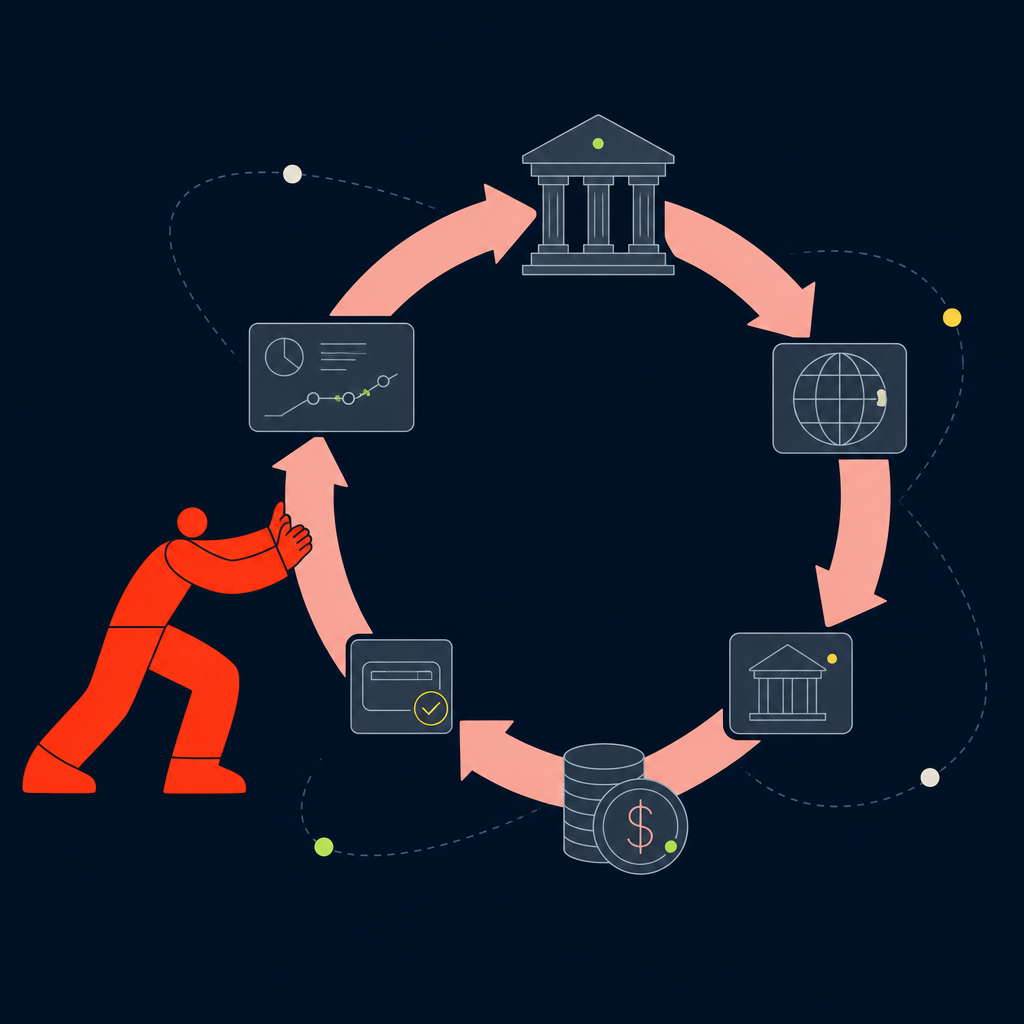
Operational mechanics for cross-border corporate payouts involve aggregating verified invoices into structured payment batches, securing foreign exchange (FX) rates, funding designated accounts, and transmitting execution files through local clearing systems or international wire networks. This process replaces manual single-wire entries with standardized data flows, ensuring predictable land dates and controlled execution timing across multiple jurisdictions.
Executing corporate payouts requires transforming approved liabilities into processed banking instructions. Traditional accounts payable departments treat contractor payouts as individual vendor bills, which creates excessive transaction fees and fragmented tracking across disparate banking platforms.
High-density workforce payouts require a centralized payout engine designed for recurring execution cycles. This engine consolidates verified invoices into coordinated payment groups based on destination currency, payment method, or processing region.
How payment batches move from invoice approval to bank rails
The lifecycle of an enterprise payout begins when invoice records receive formal approval from operational managers. Once approved, the payment engine locks the invoice data to prevent modification during the processing window.
Next, the payment engine evaluates destination details to select the optimal settlement path. Financial data from the official ECB payment statistics database shows how clearing systems process distinct payment instruments across borders to optimize settlement speed and systemic security.
Once the routing path is established, corporate treasury transfers funds into designated funding accounts. The system then dispatches execution files directly to local clearing rails or partner financial institutions for distribution.
- Invoice locking: Securing invoice amounts and beneficiary details against post-approval changes.
- Grouping: Aggregating transactions by destination currency to optimize exchange rates.
- Funding execution: Transferring total batch amounts to clearing accounts in a single transaction.
- Rail dispatch: Transmitting individual payment instructions to target settlement networks.
- Status tracking: Monitoring transaction progress to confirm successful settlement.
By managing payouts in batch cycles, enterprise finance teams eliminate repeated manual wire creation. Standardized mechanics ensure every international contractor receives payment on their expected land date without unexpected bank deductions.
Core pillars of controlled international corporate payments
Controlled international corporate payments rely on three fundamental operational pillars: automated identity and account verification, intelligent currency routing, and real-time payment status tracking. Together, these mechanisms prevent failed transfers, eliminate hidden intermediary bank charges, maintain strict compliance with global sanction registries, and provide complete workforce visibility and financial control for corporate treasury teams.
Maintaining control over cross-border payments requires structured safeguards at every step of execution. When companies operate across borders without centralized controls, payment failure rates rise and foreign exchange costs expand unpredictably.
Pre-flight validation, KYC, and account verification
Pre-flight validation verifies contractor credentials before funds enter international banking rails. Invalid bank account formats, incorrect routing numbers, or missing tax information frequently cause payment returns that require manual intervention.
Automated pre-flight checks cross-reference beneficiary details against international banking standards and Know Your Customer (KYC) anti-money laundering databases. Catching errors prior to file submission prevents bank rejection fees and avoids administrative repair delays.
Smart currency routing and FX fee containment
Foreign exchange costs represent a major source of financial leakage in international operations. Standard wire transfers sent through correspondent banking networks incur unpredictable FX markups and intermediary handling fees.
Smart currency routing directs payments through local clearing mechanisms rather than international correspondent banks. Reports based on 2023 ECB payment statistics emphasize that local clearing mechanisms process payments with lower transaction overhead than cross-border wire transfers.
- Pre-flight format validation for international account identifiers like IBAN and SWIFT codes.
- Automated anti-money laundering and sanctions screening prior to fund release.
- Direct integration with local clearing networks to bypass correspondent bank markups.
- Real-time status notifications providing visibility from funding to final settlement.
Wondering how cross-border payment operations plays out in your countries?
A Papaya specialist can map this to your actual workforce instead of the general case.
Containing FX costs while maintaining compliance requires structural automation. Corporate treasury departments that implement intelligent routing protect operating margins while guaranteeing exact payment amounts to recipients.
Glossary of corporate payment and payout terms
Enterprise corporate payments rely on precise banking terminology, regulatory frameworks, and foreign exchange execution mechanics. This glossary defines essential technical terms governing cross-border corporate payments, currency routing, clearing rails, and contractor payout infrastructure. Mastering these financial concepts allows finance leaders to evaluate payout systems, manage banking relationships, maintain regulatory compliance, and eliminate hidden friction.
Understanding technical payment terminology enables precise communication between finance, legal, and operational teams. Standardizing these definitions helps organizations establish consistent criteria when evaluating cross-border payment architecture.
Essential terms for cross-border financial engineering
Corp Payment: An enterprise financial transaction executed to fulfill business liabilities to contractors, vendors, employees, or regulatory agencies across domestic and international banking rails.
Clearing Rail: The underlying banking infrastructure or network, such as Single Euro Payments Area (SEPA), FedNow, or Automated Clearing House (ACH), that transfers monetary instructions and funds between participating financial institutions.
Land Date: The guaranteed calendar date on which transferred funds arrive and become fully available in the beneficiary's local bank account.
Payment Group: A structured batch of approved payment instructions consolidated by currency, region, or execution date to streamline funding and operational approvals.
FX Drag: The cumulative financial loss incurred through uncompetitive exchange rate markups, hidden spreads, and intermediary correspondent bank deductions during cross-border transfers.
Pre-Flight Validation: Automated checks conducted on beneficiary account data, SWIFT codes, and regulatory watchlists prior to dispatching payment instructions to prevent transaction failures.
SEPA (Single Euro Payments Area): A payment integration initiative of the European Union that simplifies bank transfers denominated in euros across member countries. As documented in published ECB payment statistics, SEPA infrastructure handles billions of cashless transactions annually across European economies.
Automating recurring payment cycles to eliminate manual friction
Automating recurring payment cycles eliminates manual administrative tasks by connecting invoice approvals, currency conversions, payment execution, and ledger reconciliation into a single operational workflow. This structure reduces payment processing times from weeks to hours, eliminates manual data-entry errors, optimizes foreign exchange rates, and ensures international contractors receive predictable, timely disbursements on their land date.
Enterprise contractor workforces generate high invoice volumes on regular monthly or bi-weekly cycles. Processing these recurring transactions manually through separate spreadsheet uploads and banking portals creates severe operational bottlenecks.
Automated recurring cycles replace fragmented steps with connected execution. When an operational manager approves a contractor invoice, the payment platform automatically queues the transaction into its corresponding payment group.
Using SEPA and local clearing rails for European contractors
Executing payments across European countries requires using direct clearing infrastructure. Using local rails like SEPA allows companies to process euro payouts with domestic execution speeds and predictable fee structures.
Data compiled in the 2023 ECB payment statistics release shows that credit transfers across European clearing systems handle trillions of euros in transaction value each year. Using direct local clearing connections enables companies to access these rails without relying on expensive international wires.
Automating reconciliation to eliminate manual ledger updates
Month-end financial closing often stalls when finance teams spend days manually reconciling bank statements against individual ledger entries. Unmatched transaction totals, currency discrepancies, and bank fee deductions complicate accounting workflows.
Automated reconciliation systems log every transaction status change in real time. Upon settlement, the software automatically posts matching entries back to general ledger accounts in enterprise accounting software.
For enterprise organizations managing distributed contractor workforces, implementing a dedicated contractor payment platform establishes operational predictability. By unifying invoice routing, KYC checks, local clearing access, and accounting synchronization, finance teams maintain tight operational control over global payouts.
Platforms like Papaya Global provide continuous visibility over recurring payout cycles across international operations. Centralizing global payment execution protects corporate liquidity while delivering transparent payment tracking to international workers.
- Automatic grouping of approved contractor invoices into scheduled execution runs.
- Direct connection to local clearing networks to reduce cross-border settlement fees.
- Real-time two-way synchronization between banking rails and enterprise general ledgers.
- Consolidated funding requirements reducing multi-currency bank account requirements.

Establishing Finance control over multi-country corporate payouts
Establishing finance control over multi-country corporate payouts requires centralizing governance into a single operational framework. When regional subsidiaries manage contractor payments independently, enterprise leadership loses oversight of daily cash flow, regulatory exposure, tax obligations, and total transaction costs. Decentralized payment methods create fragmented data across local banks. This fragmentation makes consolidated financial reporting difficult. Replacing fragmented regional processes with standardized treasury workflows requires teams to unify approval hierarchies and enforce automated compliance checks across every transaction stage. Structured operations lower foreign exchange costs and remove compliance risks to bring predictable execution to international disbursements.
Centralizing payment operations into a governed framework provides clear visibility across all payout activity. Without a unified system, treasury leaders cannot easily confirm whether local subsidiaries use optimal foreign exchange rates or adhere to compliance rules. Modern cross-border payment processing architecture gives treasury leaders tools to monitor settlement statuses and audit foreign exchange rates. Finance directors can also enforce compliance rules across international teams. When treasury teams lack central visibility, individual subsidiaries often accept unfavorable exchange markups from regional banks. Controlling these variables from a central office stops duplicate payments and eliminates hidden intermediary fees. This centralized control establishes total cost clarity before money leaves corporate bank accounts.
Connecting corporate funding accounts directly to licensed payout rails allows organizations to maintain audit readiness and absorb local regulatory complexity across more than 180 supported countries for workforce coverage. Each country maintains unique banking rules and tax documentation standards. Standardizing compliance verification and payment execution before initiating transactions prevents operational friction and supports long-term growth.
By managing international disbursements through Papaya Global's workforce payment platform, enterprise finance teams maintain direct financial control over multi-currency payout cycles. The platform pairs automated pre-flight checks alongside competitive foreign exchange execution. It also provides real-time tracking. Pre-flight checks verify account details and beneficiary data before transmission, which prevents transfer rejections and bank return fees. Real-time tracking gives finance leaders immediate confirmation when payments settle. Treasury departments can then reconcile global workforce balances without waiting for end-of-month bank statements.
Frequently asked questions
What is a corp payment and how does it differ from regular payments?
A corp payment is an enterprise financial transaction executed to settle corporate liabilities such as contractor invoices, supplier bills, payroll, or tax obligations across domestic and international banking rails. It differs from regular consumer payments in transaction volume, structural complexity, multi-level approval requirements, regulatory compliance checks, and automated general ledger reconciliation.
How can Finance evaluate payment companies for a distributed workforce?
Finance teams evaluating payment providers for a distributed workforce should analyze payment control, execution speed, foreign exchange transparency, local clearing access, and talent experience. A compliant provider must offer automated pre-flight validation, regulatory compliance coverage, real-time status tracking, and direct accounting integration rather than manual transfer capabilities.
How do SEPA payments work for European international contractors?
SEPA payments process euro transfers across member countries in the European Single Euro Payments Area using standardized banking protocols. By accessing local SEPA clearing rails directly, organizations execute international European contractor payouts with the speed, low cost, and reliability of domestic bank transfers while avoiding correspondent banking fees.
How can a business reduce cross-border payment complexity and FX drag?
Businesses reduce cross-border payment complexity by batching contractor invoices into structured payment groups, routing payouts through local clearing rails, and automating pre-flight account validation. Replacing traditional international bank wires with direct local clearing integration eliminates hidden intermediary correspondent fees and minimizes foreign exchange markups.
The next step is cross-border payment operations in your own setup
Bring your countries, worker mix and payment cycles to a Papaya specialist and get a straight answer on what changes.